
Your Building Is Talking. You're Just Not Listening — And It's Costing You Six Figures a Year.
By Jason Gotcher | PropAITools
There's a multifamily operator in Dallas who lost $340,000 in turnover costs last year. Not because the market softened. Not because rents got squeezed. Because his "tenant retention strategy" was a quarterly survey and a fruit basket at renewal time.
Meanwhile, his building was screaming.
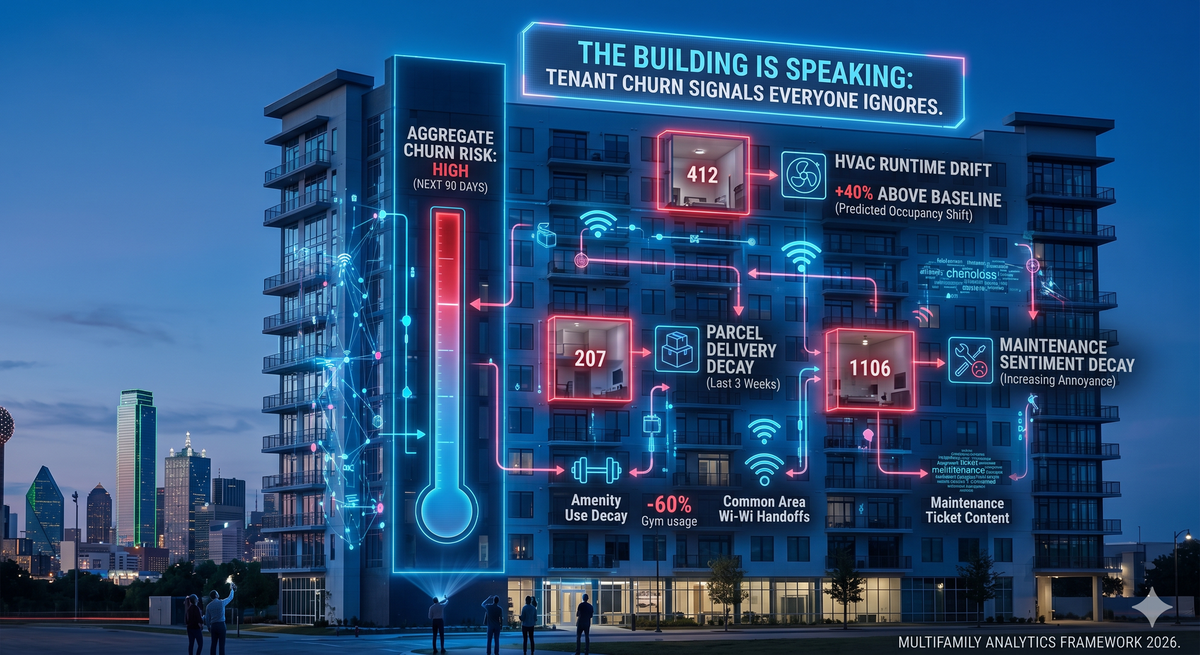
The HVAC runtime data showed unit 412 had been cycling 40% above baseline for six weeks — classic signal of a tenant who's home way more than usual (read: working from home, considering options, touring competitors on lunch breaks). The package locker logs showed unit 207 had stopped receiving Amazon deliveries three weeks ago — they'd already updated their shipping address somewhere else. The maintenance portal showed unit 1106 had filed four "minor" tickets in 30 days, each one progressively more annoyed in tone.
All three didn't renew. All three were predictable. None were predicted.
Here's the uncomfortable truth about "tenant churn analytics" in 2025:
Most platforms are selling you a rearview mirror in a sports car frame. They flag "at-risk" tenants based on lagging indicators — late payments, complaint volume, renewal survey scores. By the time those flags trip, your tenant has already toured three competitors, signed a lease somewhere else, and is mentally packing boxes. You're not predicting churn. You're documenting it.
Real predictive infrastructure pulls from signals tenants don't know they're sending:
- HVAC behavioral drift — sudden changes in occupancy patterns
- Parcel and delivery cadence — the single most underrated churn signal in multifamily
- Amenity badge-in decay — gym usage drops 60 days before a non-renewal, on average
- Maintenance ticket sentiment, not just volume — the words matter more than the count
- Common area Wi-Fi handoff patterns — are they spending less time on-property?
The operators winning right now aren't the ones with the prettiest dashboards. They're the ones who figured out that a building generates roughly 400 data points per unit per week, and 380 of them are getting thrown in the trash.
Your spreadsheet is not a strategy. Your quarterly survey is not a signal. And your "tenant experience platform" is not predictive if it's telling you what already happened.
The buildings that will outperform in 2026 are the ones being read like a book today. Everyone else is going to keep getting surprised by "sudden" non-renewals that were broadcasting their intent for 90 days.
Listen to the building. It's been trying to tell you something.